"The Art of (The Formans) Racing in the Rain"
Not so long ago (July 7th, 2012), we set out on a new adventure: a three-day weekend in
Nikko (pronounced
nee-ko), which is 2 hours by train from Tokyo. Every Japanese person who heard we were going said the same thing: "Oh, that is
very Japanese!" But what does that
mean, exactly. Well, if someone told me they were going to Niagra Falls and then going to spend a weekend in the Catskills, I'd say, "Oh, that's so
American." (Okay, maybe I'd say a few other things, too, but I'd definitely make some remark on how American it seemed.)
Well, Nikko's kind of like that. It is full of natural wonders, middle class resorts that specialize in onsens (hot springs) golf, and hikes. It is a popular weekend getaway from the big city (in this case, Tokyo) for just about anyone and everyone.
 |
| I took this photo off the web; it's a nice representation of the region. Nikko is nestled into the mountains. |
Much like Kyoto, it's a "must see" if you are a middle school student in Japan. Like 6th grade classes in the U.S. flocking to Washington, DC, busloads of kids descend upon Nikko regularly for a full dose of culture. (Note: school is NOT on summer vacation in Japan.) What's not to like?
A few things to remember before reading on: it's the rainy season, Honshu (the island that is home to Tokyo, Kyoto, Osaka, Fukishima, etc.) is mountainous and covered in dormant volcanoes, and there are more religious shrines and temples than Baptist churches in The South.
Like most great adventures, this one started on a train; in this case, the Tobu Spacia. (At some point in the future, when it does not give me PTSD, I will post about my experiences booking weekend trips in Japan. Once on a train and traveling, it is fantastic. The blood, sweat and tears required to understand the arcane world of Japanese travel is decidedly not.) Here's the train (note shirt matches train):
Before we knew it, we had arrived in Nikko:
 |
| (Note the Hokkaido Fighters baseball cap and peace sign. Very Japanese, he is.) |
 |
| Nikko Tobu Station in the rain. |
|
|
|
There are two train stations in Nikko: Nikko Tobu and Nikko JR. Each one is owned and operated by a different company. In our case, it was the Tobu company, which also owns and runs many of the buses in the Nikko area. But,
Nikko JR is more interesting. All indications are that it was originally designed in by Frank Lloyd Wright and built in 1915, though it was operating from the late 1890s as a train station. Interestingly, I have not been able to find much reliable information on Wright and his connection to the train station online. From the link you'll see it is not what you'd expect from Frank Lloyd Wright--at least not if you are familiar with his more famous works. (Not sure what to think about this. Might need to dig a little deeper at some point.) But I digress. What you really want to see is pictures of us sightseeing in the rain.
Here's the simple story of day one: lots of walking in a downpour. Clueless (we thought the weather was going to be intermittent rain showers at worst), we left our hotel,
the Nikko Green Hotel (also known as Fuwari Natsukashiya) on foot:
 |
| Perhaps the moss-covered wall should have been a good indication of the amount of rain we'd see. |
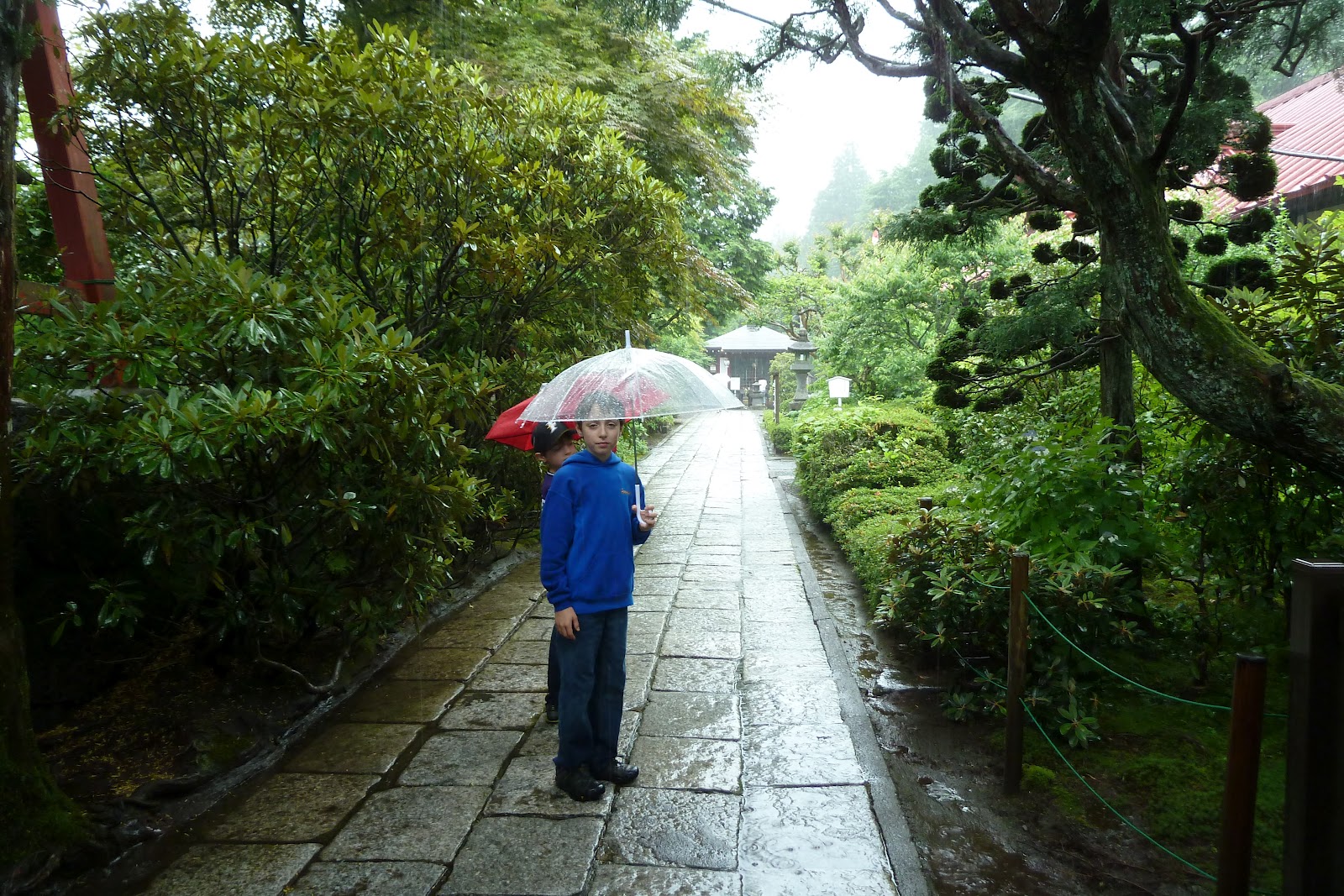
First stop: the Graves of the Self-Immolations. Not part of the official World Heritage Site, but fascinating nonetheless. According to the Nikko Historical Walking map we used, there are 24 gravestones. Five of those who died were retainers of the 3rd Tokugawa Iemitsu Shogun. The other 19 were "vassals who devoted themselves to the Tokugawa shogunate." They died on April 20, 1651. It's a grim tale, I know, but it's a gorgeous, enchanting place, with innumerable shades of green.
A rolling stone gathers no moss, so we set out to find yet another a small shrine that was not part of the World Heritage site: Jokoji Temple. It took awhile. First, a diversion:
 |
| Down a local side street, we happened upon this neighborhood. When it's not foggy and raining, there are mountains in the distance. |
 |
| For a long minute I imagined myself living here. It's so charming. I miss my front porch. |
 |
| I laugh now when I remember that we were scolding the boys about staying out of the water. At this point AH was bragging that his shoes were waterproof. Not for long. |
 |
| About 15 minutes later, we were lost and very wet. Over the bridge and then... |
 |
| back over the bridge. Still no shrine, and starting to get hungry. |
But, before long, we were back on track and had reached the Jokoji Temple:
Basically, from what I can understand from the tour map (which often has cryptic explanations), the shrine is dedicated to the head of a Jizo statue which was washed away in a flood in 1902 and found later by local people on the riverbank. The recovered head is called Kanman-Oya-Jizo-On-Kubi, and it was enshrined in the Jokoji Temple, though I am not sure if the Jokoji temple was already there or was built just for the Jizo statue that was found.
Jizo is a Buddhist bodhisattva which basically helps those who need it. Like most Japanese shrines (Shinto) and temples (Buddhist), it is not strictly one religion; there are Shinto and Buddhist elements in the shrine. My photo of the actual recovered Jizo didn't turn out so great, but it is basically a large version of one of these:
The temple area was covered with Jizo statues. The red hats and bibs are meant to give extra help to Jizo. Red is an auspicious color for more reason than I could ever enumerate. (The Jizo link above does a nice job, though.) Personally, I think they are rain hats. Here are a few more photos from the temple:
Many people have left strings of a thousand paper cranes, which is a symbol of good luck. They were beautiful and intricate and utterly fascinating. We see them often at temples, and they never fail to enchant me:
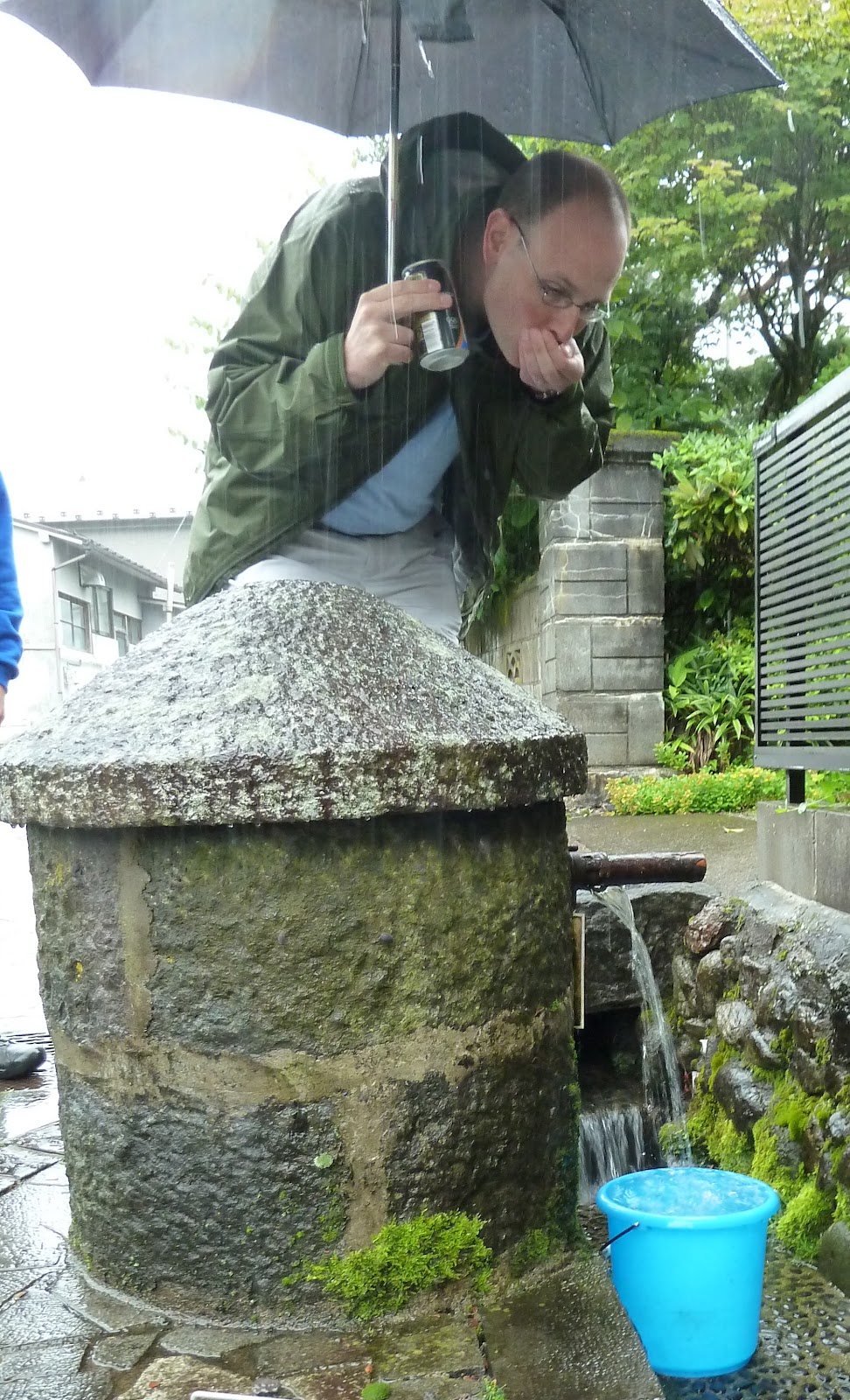
It was time to move on...we slogged our way toward lunch, but not before stopping at a "stone cup," a public water fountain that was first built for the workers who lived in this neighborhood centuries ago when the temples and shrines in Nikko were first built to honor the Tokugawa shogunate. This street is lined with several of them. Fresh mountain spring water on a fresh mountain rainy day:
 |
| No doubt the bucket is a recent addition. |
It's raining, it's pouring, but a good walk is never boring:
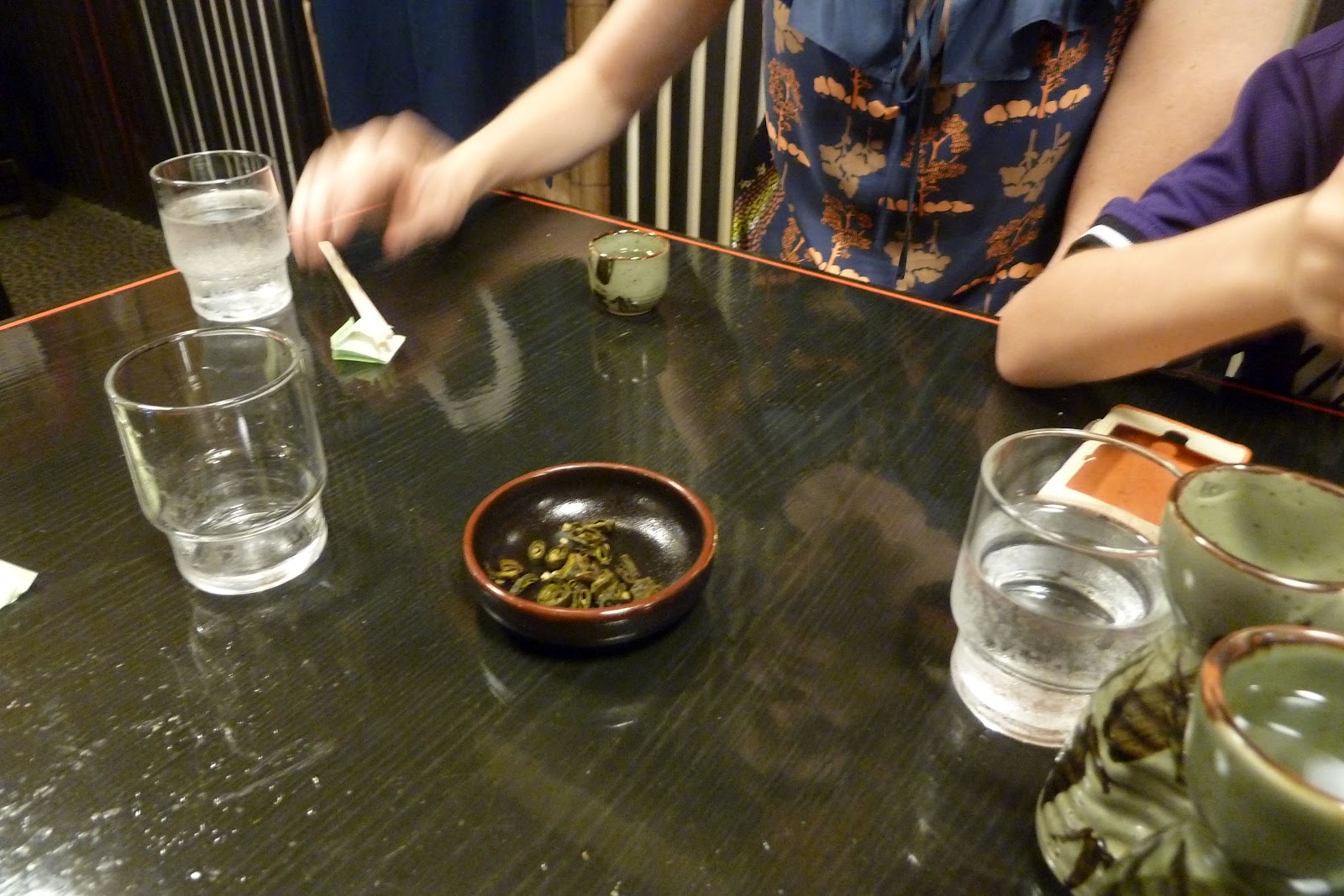
Luckily, we stopped into a nice, warm place for lunch. Hot sake hit the spot. We were given a small green dish of dried something or other. Frank suggested I try it out. I did:
 |
| "What is it?" "I don't know. Why don't you try it?" "Okay." |
|
|
|
|
 |
| "I guess I eat it like this?" |
 |
| "Damn it! It's HOT! Sake!" | | |
|
After lunch, we hopped a bus into the main part of town so we could
check out main street. Turns out many of the shops were closed. I am
guessing due to the rain, since it was a Saturday and things would
normally be open. We were one of the few groups (of idiots) we
saw out walking in the rain.
 |
| A shop full of the carved wood that Nikko is famous for. |
 |
| Tenkai, a Buddhist priest who was very trusted by the first Shogun Tokugawa Ieyasu. |
When I saw the statue of Tenkai it hit me:
everybody in Nikko knows it rains constantly. Even the statues have raincoats. It was not a happy realization.
 |
| Frank took this picture of the famous Shinkyo Sacred Bridge. It's one of my favorite photos. |
 |
| We found two Canadian guys who were as determined as we were to see some of Nikko, rain be damned. They took this picture for us. They were smarter than we were, though. They had raincoats. |
At this point, we had had enough. We were ready to dry off. We waited (yes, in the rain) for almost an hour for the bus to come. It never came. As we walked home in the downpour, only one thought kept me sane: the onsen at the hotel. Next post: Onsen (hot spring) time!