What you'll find on Storybook Days

The Home page displays all my musings on life in Japan and a few other things (baseball and children's books are distinct possibilities). For highlights only: "A Day in the Life (edited)." "Tabemono (Food)" is exactly that. "Big in Japan" is my completely biased and oversimplified list of what is popular in Japan, and "Kimono Count" is a day-by-day record of the people I see in traditional dress. "Editor's Delight" catalogs the unintentionally amusing and apparently quite complicated world of Japanese-English translation. "Uncle Tucker" tracks our sightings of a certain cat following us around Japan.

Tuesday, June 19, 2012

Raining Cats (and Dogs)

It's rainy season in Tokyo, so why not take a walk in the pouring rain to the local cat café?

How does one find a cat café?  With a cat café map map, of course.  I'll admit, I was a skeptic.


Following up on a lead from my Tokyo-savvy, cat-loving friend, Annie, I looked up the neko café (cat café) culture in Japan, and here's what I learned:  The cat café phenomenon is relatively new (less than 10 years old) and was started to give people a place to relax and cuddle felines when they can't afford to have their own.  (Space is limited, esp. in cities like Kyoto and Tokyo, and pets are quite expensive.  CNN reported on it, so it must be true, right?)  Guess what?  It turns out that cat houses are fun for the whole family!


Different neko cafés charge different amounts.  The one pictured above is in Kyoto, and it was over 1,000 yen for 30 min.  (FYI, 750 yen = $10).  We didn't go in.  However, the one we found in Tokyo was about half that price (530 yen for 30 min.):  Neko JaLaLa:


Cute logo, isn't it? nekojalala.com  (It helps if you read Japanese.)  Here's the price structure:


First, pay.  Then tuck your shoes away and head straight to the bathroom to wash your hands.  (You wouldn't want to bring in any germs, would you?)

 
We had this creepy little fella ensure we washed properly.  (Turns out he continued to follow us all over Japan in different guises, but that is for another post.)


I know what you are thinking:  Did it smell? (No, not really.)  Was there cat hair everywhere?  (No, not at all, even though most of the cats are long-haired cats.)  Where do the cats live?  There was a cat door on one side of the room where the cats could "escape" when they had had enough.  The cat cafés are pretty well regulated, with cats being ensured adequate time alone without human contact, allowed to roam freely, and not overexposed to light (in other words, lights out at night).

After we are nice and clean, we head out to meet the cats and order our drinks--it is a café after all.  Two Cokes, a Sprite and at least 20 cats.  Now THAT'S a recipe for fun!


Choose a toy or two and then it's up to you to find a friend or two to share your 30 minutes.


There are (at least) 4 cats in this picture. Can you find them all?
Here a cat,

I called this kitty Lovey Love.  She was my favorite.  Note awesome cardboard bed.

there a cat, 

This luxury high rise is about the size of the average Tokyo apartment.
EVERY(freaking)WHERE a cat, cat.

I know.  I know.  ADORABLE.  We called him Teddy.  He didn't look real.  Impossibly cute.
With so many cats to choose from, it was helpful to have this handy souvenir take-home folder with (almost) all the cats' names on it:


This little fella, Jack, was a huge hit, because he looks like our own Jojo, whom we miss very much:


But, in the end, one cat stood out from all the others.  His name was Coo, and he is the biggest (tallest) cat I have ever seen.  He's the Manute Bol of felines--at least as big as an adult Blue Healer (my family's dog of choice).  I tried over and over to get pictures that would give a sense of his size.  I really do think you had to be there, but at least I tried.  I'd hate for you to miss out:


At first, Coo was perched on top of the bookshelf and didn't want to come down, but the lovely cat lady helped get him down:


Coo finally agreed to come down and meet his adoring (or simply awestruck)   public.

A few photo ops

See how huge Coo is next to all the other cats in the café? 

and then the cat lady handed me this:


a ball to use when playing with Coo.  A hairball, that is.  Made entirely from Coo's fur.  Suddenly, enough was enough, and our little visit came to an end.  We said farewell and promised to visit again soon (assuming we can avoid the hairball) and headed back out into the rain singing Ja-La-La!

(And yes, dog lovers, there appear to be dog houses, too.  But I ask you: who wants to be in the dog house? A cat house is much more fun.  But just for you dog lovers out there...a moment of Japanese dog café video zen.)

Wednesday, June 13, 2012

Tokyo Little League!

    After months of anticipation, the boys finally got their first taste of Japanese baseball (yakyu).  We headed to the field, not quite sure what to expect, but armed with a good map and a pretty good sense of direction.  AH was the first one to spot the field, and we soon had a few hints that we're not in Iowa anymore, Shoeless Joe:


Kind of looks like a Bronx school yard, doesn't it?  Except that the surface is clay, not asphalt.  Clay surface.  So much for cleats.  No bases or diamond.  Just a large, L-shaped multi-purpose area, because like most cities, Tokyo puts a premium on its space.  Especially open space.

    Another big difference:  a rubber ball that bounces just like a tennis ball.  Maybe even higher.  If you don't catch it in the air, it's impossible to run it down, so you better catch it. 

AH with ball (Saikawa Kantoku in back)
But maybe the biggest difference is this:  No one (and I mean no one) does anything until the coach tells you to.  The first thing Saikawa Kantoku (kantoku means "head coach") told the boys:  "In Japanese baseball, no one does anything until the coach tells you to.  No catch.  No throw.  No bat.  It's dangerous."  Ouch.  IW's prospects were not looking so good, and when the coach lined up the kids, I was not sure if I should laugh or cry.  Not my kids.  No way.


    After a quick line up, Saikawa Kantoku gathered the team around him and introduced our boys:


At this practice, 16 kids showed.  Practices last 3 hours on Saturday and then games are on Sunday.  If there are no games scheduled on a given Sunday, you have another 3 hour practice.  Games play for one hour and end based on time played, not innings played.  All that practice for only an hour of play a week.

    The organization of the Little League team here is very different from in the U.S.  This "team" is really more like a club. They are all known as the Fires, though there are teams for all ages and levels.  The boys play in the level for 7-10 year olds.  There are almost 30 kids on the team--2 of them are girls.  (Girls don't play softball here until middle school.)  There are "A" teams and "B" teams, and each team plays the best players in the official games, though they hold "unofficial" games so that everyone gets to play at some point.

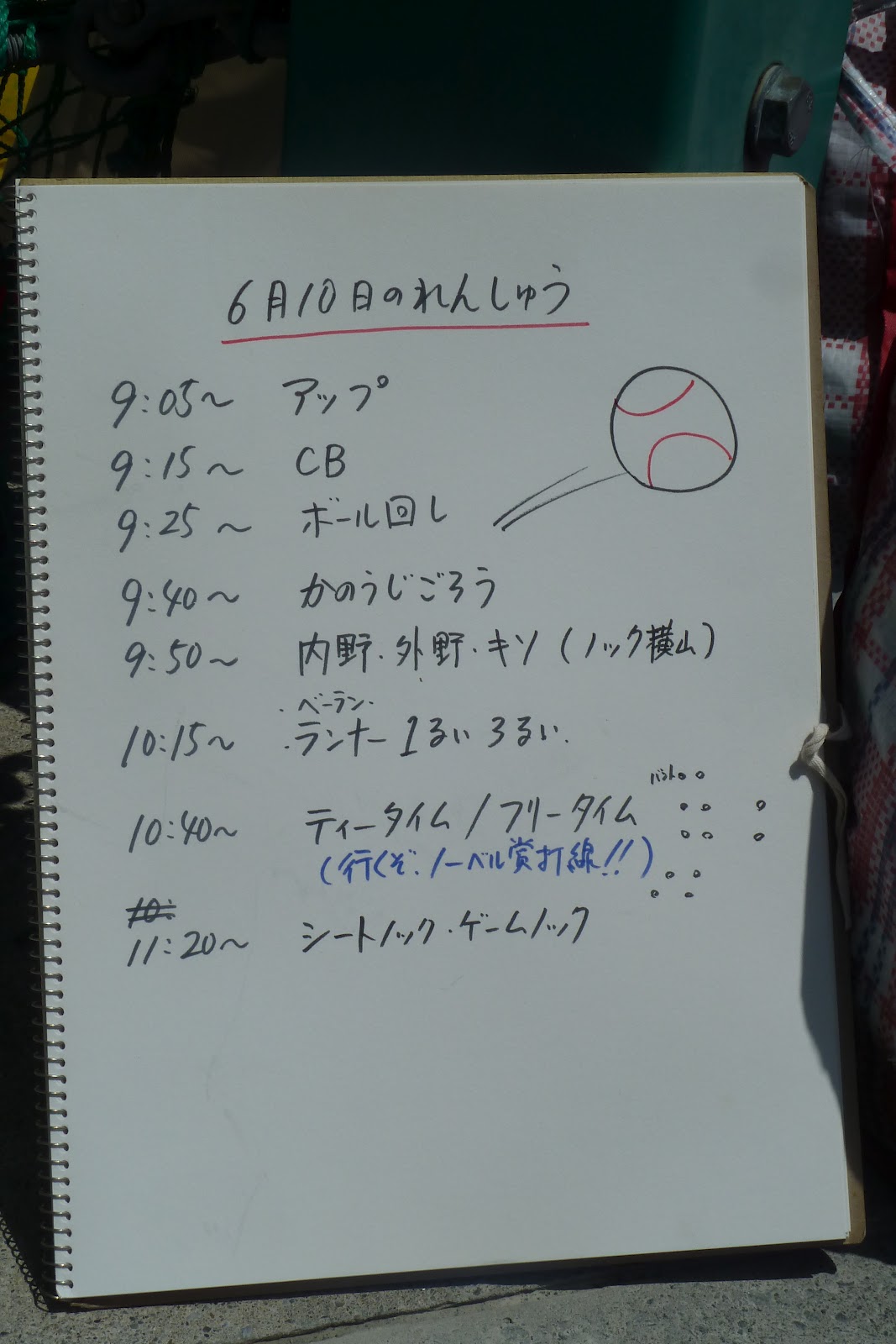
Once the introductions were done, the kids headed off to practice.  Single file.  And then something miraculous happened.  They had fun.  Serious fun, but fun nonetheless.  How serious? Check out the schedule:


First a little catch:


Then a little fielding:


How to field (coach bats; "batter" runs as though it was his hit).  No one pitched at all except for the coaches.


How to run to first:


How to slide into second:


How to bat:


Then fielding again. And batting.  And base running.  Each aspect of baseball (running to first; sliding, etc.) was broken down into its smallest possible component and then drilled again and again.  It was hot and sunny, so they took a lot of breaks.  But no one complained, and no one dragged their feet.


    During practice we were told that parents are encouraged to help with the team or coach.  I explained that back in the U.S., I coached, but that here I would just help out.  One of the coaches explained, politely, that yes, in Japan, it is best if the mothers help with the team, not coach.  Even though this did not surprise me at all, I had to swallow hard and calm the nerves.  Not that I want to coach here.  I just don't like being told that I can't or shouldn't, no matter how polite.  There's no place like home.  There's no place like home.  There's no place like home.  Frank said that he was happy to help, but he doesn't coach, even at home.  Good man, my husband.  Good man.  He knows how to get along.  He makes it look so easy.

    When all was said and done, the first thing we asked the boys:  "Did you have fun?"  They both broke into wide smiles:  "Yeah, but we're tired."  Good enough for me.


Practice over, IW reverts to his usual lack of seriousness


Saikawa Kantoku gave the boys their official hats


and AF was invited to "play up" at the 11-12 age level.  Though it was a compliment to him and would mean playing in their "majors" (which is part of the all-Japan tournament series, which feeds into to the Little League World Series in PA), we just couldn't allow it.

    I am the most gung-ho baseball mom you'll find.  I love it.  Just LOVE it.  I'll spend every weekend at the ball field watching tournament games.  But that was not what was asked.  Playing up would require that we spend 8 hours (9 to 5) every Saturday practicing.  PRACTICING.  Sundays would be for games.  Call me crazy, but that seems the surest way to kill my (American) kid's love of baseball.  (Not to mention our weekend.)  8 hours of games, maybe.  But 8 hours of practice.  Forget it.  Besides, we have an entire country to see in a short period of time.  3 hours of practice every Saturday and a game on Sunday is enough.
     Here's a pretty spot-on description of Little League here in Japan by Gordon Edes from 2008:  Little League in Japan.  I want to say that I find practicing 8 hours every Saturday interesting in a "culturally enlightening" kind of way, but I just find it sad and impossible to believe that it would be fun.  At least not fun in the sense of the word as I know it.  Maybe fun for kids here in Japan (at least many of them) has to do with feeling you have accomplished a goal, even if it is set for you by someone else.  Even if (or perhaps because) it envolves intense discipline.  I think that generally, though, in the U.S., fun for kids comes from feeling independent and accomplishing goals.  We're foreigners in a foreign land, and even the familiar is strange.  At least there aren't any flying monkeys.