A Stomping Good Time
Undaunted by my recent trip to the ER courtesy of a big knife and an unruly carrot, I took the boys to a cooking class this week. We headed out promptly at 9 AM to brave the Tokyo Metro at rush hour and make the hour-long trip southwest to meet Elizabeth Andoh, author of
Washoku and
Kansha, two English-language cookbooks devoted to Japanese cooking principles and styles, as well as blogger and keeper of the Japanese cooking website,
Taste of Culture; Ms. Andoh is an all-around Japanese culinary specialist, but she is much more than a foodie; she is an invaluable link between Japan and the United States. Born in New York and raised on the Lower East Side of Manhattan, Ms. Andoh has lived in Japan since the early 1960s (with a brief stint in the U.S. in the 80s). Her Japanese is impeccable, and her knowledge of Japanese culture, food, and history is encyclopedic.
Our class, "Udon Noodle Stomping,"--part of her "Taste of Culture" cooking class series--was geared to kids and was to last from 10:30 AM to 2:30 PM and include lunch. Her advice: eat a big breakfast, because lunch would be late (1:30 or later). IW is perpetually hungry, so I was careful to heed her advice. First, before leaving the apartment, we had our usual breakfast. Then, at 10:00, just as we were nearing our destination, we stopped and topped off:
 |
| Some kind of roll with whipped cream and a hard chocolate sauce. |
 |
| Croissant with bittersweet chocolate center, hard milk chocolate sauce and almonds. Mine. All mine. |
|
|
Properly fueled, we headed out on the last leg of our trip--a 5 or so minute walk to Ms. Andoh's kitchen. Here's what we found:
 |
| Elizabeth Andoh with the boys; she is just as kind and patient as she looks. |
Tucked into her incredibly efficient kitchen were 5 adults and 5 kids. Ms. Andoh has obviously been doing this for awhile, because she knows the two most important things: (1) keep the kids (young and old) interested and (most importantly) (2) keep things moving. My boys, who had previously announced themselves determined to be bored, were captivated, which is no small feat. (As an amateur baker who has hosted many (countless?) cookie decorating parties for kids over the last 6 or so years, I was extremely impressed.)
We wasted no time getting down to business. First, we made brine for making the noodles. Like any serious cook, Ms. Andoh is as interested in the chemistry of cooking as the flavors. (She is also a former medical student, which undoubtedly helps.) She lead the kids in a discussion of making brine comparable to the salinity of the sea. (Every kilogram of saltwater has approximately 35 grams of dissolved salts in it.)
After a few calculations with the kids to ensure a proper ratio of salt to water, they donned aprons and proceeded with making the dough.
We quickly learned one big difference between Italian pasta and Japanese noodles: no eggs. The udon was made with flour (whole wheat, to accommodate the desires of Americans) and brine. One of the issues with whole wheat flour is that it does not absorb water (or brine) as readily, so it takes longer to prepare. Also, we learned that warm water absorbs faster, so we used warm brine.
First, the kids chose a bowl, a packet of flour, and a work space:
Next, they worked to ensure that there were no lumps in the flour:
Once the lumps were gone, the kids added the warm brine. Unlike pasta, the liquid is not added in the center. Instead, it is added slowly around the outer edge:
Mixing the flour and brine was very much like mixing water into flour when making pastry dough. The ratio of brine to flour is something that is perfected over time--years, I suspect. But, in the meantime, the kids gave it their best shot:
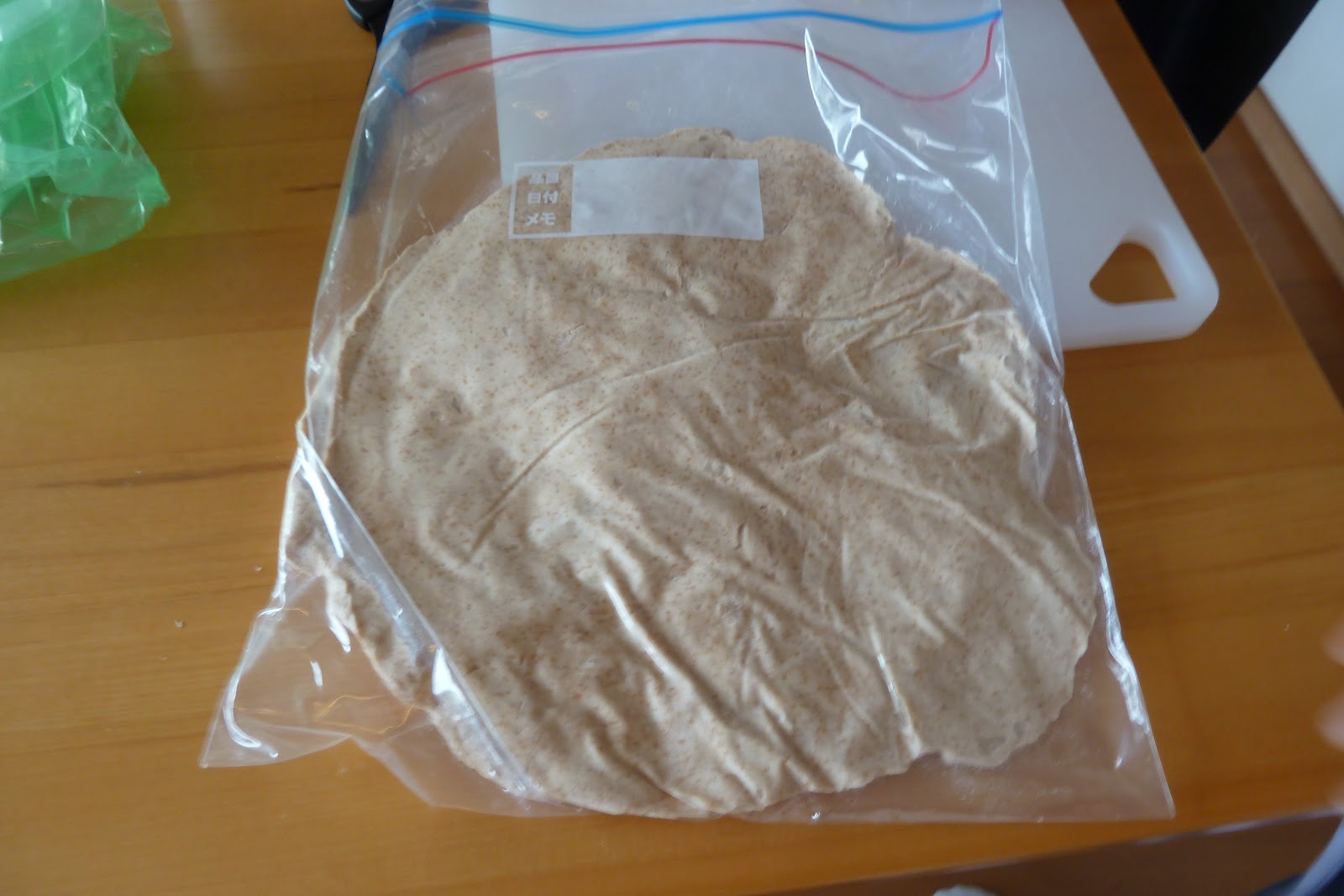
The dough was tough and hard to work with, but in the end, they each had a lump that looked something like this:
Each kid put his or her lump into a Ziplock bag to let it rest for 30 minutes, just like when making bread. While the dough was resting, there was work to be done making seasoned soy concentrate, which we would need later. This is where things got very interesting (and smelly):
First, you gather what you need: niboshi, which is a dried fish (a relative of the sardine, but larger), dried seaweed, and a thinly-sliced and smoked katsuboshi (tuna), shitake stems, soy sauce (with no additives--yes, it does exist), sugar, and sake (no sugar added). Ms. Andoh explained that in the Japanese kitchen, there are three cooking staples: soy sauce, sugar, and sake, and the ratio to use them in is usually 3:2:1. (She explained that these are roughly the equivalent of the U.S. staples of salt, pepper, and butter.)
 |
| Ms. Andoh explains the uses (l. to right) of sugar, katsuoboshi, shitake stems, and seaweed. |
 |
| And now for the really smelly stuff--Niboshi. |
 |
| Bet you didn't know...when choosing niboshi, you want one that is bent--that shows it died fighting and was therefore healthy (genki). |
Once we had all the ingredients together, it was time to get a little dirty, snapping off the fish heads and gutting them. Just to bring you this moment, gentle reader, I have conquered iMovie and edited a video. This first one I call "Gut the Fish":
 |
| Note fish: no head |
 |
| Note this collection of fish heads. There was much debate about what to do with them among the kids. My boys made particularly loud arguments about taking them back to NY for our cats, Mugsy and Jojo, which we miss terribly. It took awhile to convince them that U.S. Customs probably wouldn't allow it (not to mention their mother). |
 |
| Mmmmmm....fish guts. |
 |
| Fish heads bagged for someone (NOT us) to take home to the nekko (cat). Everything else in the jar to make the concentrated soy sauce. |
With all the ingredients assembled in the jar, Ms. Andoh tossed them into a sauce pan with the soy sauce, sugar, and sake.
She then simmered it for awhile and to make the seasoned soy concentrate:
While the sauce concentrate was simmering, it was time to grate and chop and get ready for our first meal: cold
udon salad. We used a handy dandy plastic grater for the fresh ginger, and a fabulous ceramic grater for an entire (huge)
daikon (radish).
 |
| On the left is a bowl with cheese cloth that is straining the grated daikon, which is often served with tempura; you mix the grated daikon into the tempura sauce. Yummm. |
 |
| There was LOTS of grating to do. Everyone (including parents) got a turn. |
The chopping and grating included
chikuwa and
tamago yaki, which you can buy prepackaged. To me,
chikuwa looks a bit like a hollow
churro, but it is about as different as can be.
Chikuwa is fish paste that has been applied around a bamboo stick and roasted. Once cooked, the bamboo is removed, leaving a hole. I realize that the words "fish paste" make most Americans cringe; I admit that there is nothing even remotely appetizing about the term. But, that's what it is, and you'll just have to trust me that the result of the bamboo stick roasting is a long (about 8 inch) tube of roasted fish paste that makes a scrumptious light snack (or noodle topping). The inner texture is similar to the whites of hard boiled eggs, but it is much tastier. Here's what they look like when sliced and ready to eat. The
chikuwa is on the left, and the ubiquitous and very tasty
tamago yaki (rectangular tidbits of slightly sweet egg omelet) is on the right:
 |
| Photo courtesy of IW, who took some time off from cooking to snap a few photos. |
Once the chopping and grating was done, Ms. Andoh moved on to making the secondary soup stock, which actually reused the mushrooms, fish, and seaweed from the seasoned soy concentrate recipe. First, she strained the liquid from the seasoned soy concentrate and set it aside for making
ponzu sauce for the cold noodles.

Then, she made soup broth for the warm noodle dish that we would have at the end of the class. At this point, Ms. Andoh announced that snacks were available for anyone who needed a nosh before the cold noodle lunch. Lots of yummy crackers and cold (decaf.) 16-leaf tea were set out:
Soon the moment arrived that all the kids had been waiting for: Noodle Stomping!
Ms. Andoh set up each kid on a space in her tatami room and showed them how to wrap the Ziplocked dough into a thin, plastic pad for stomping:
Once the dough was securely wrapped, the kids set about stomping. The key was to use the heel. The udon dough is impossibly stiff, so working it requires quite a bit of force and determination. Luckily, the kids were up to the task:
 |
| Sometimes a little rearranging was needed. Of course, a video is always instructive: |
Successful stomping turns out dough like this:
But how do you know if it is done? Good question! The answer is that it should have the resistance of your ear lobe (
mimi tabu). (This was one of those "lost in translation" moments that is really best described as "It's a Japanese thing.")
We found Ms. Andoh's alternative description more helpful: it should hold the impression from your finger slightly pressing into it:
We soon discovered that AH's dough was too dry and IW's dough was too wet. Solution? Combine them, of course!
With the dough flattened, it was time to let them rest while we ate our first course: the cold noodle salad. Ms. Andoh had wisely prepared these noodles before class so we could eat while our own noodle dough was being prepared. At this point, I'll let the photos do the talking:
 |
| The sumo hashi (chopstick) holders were a big hit! |
 |
| Grown-up table (tatami room in the background) |
 |
| So patient... |
 |
| Ms. Andoh pouring the ponzu sauce we had made for the cold noodles. |
 |
| Note the cool sesame seed grater. |
 |
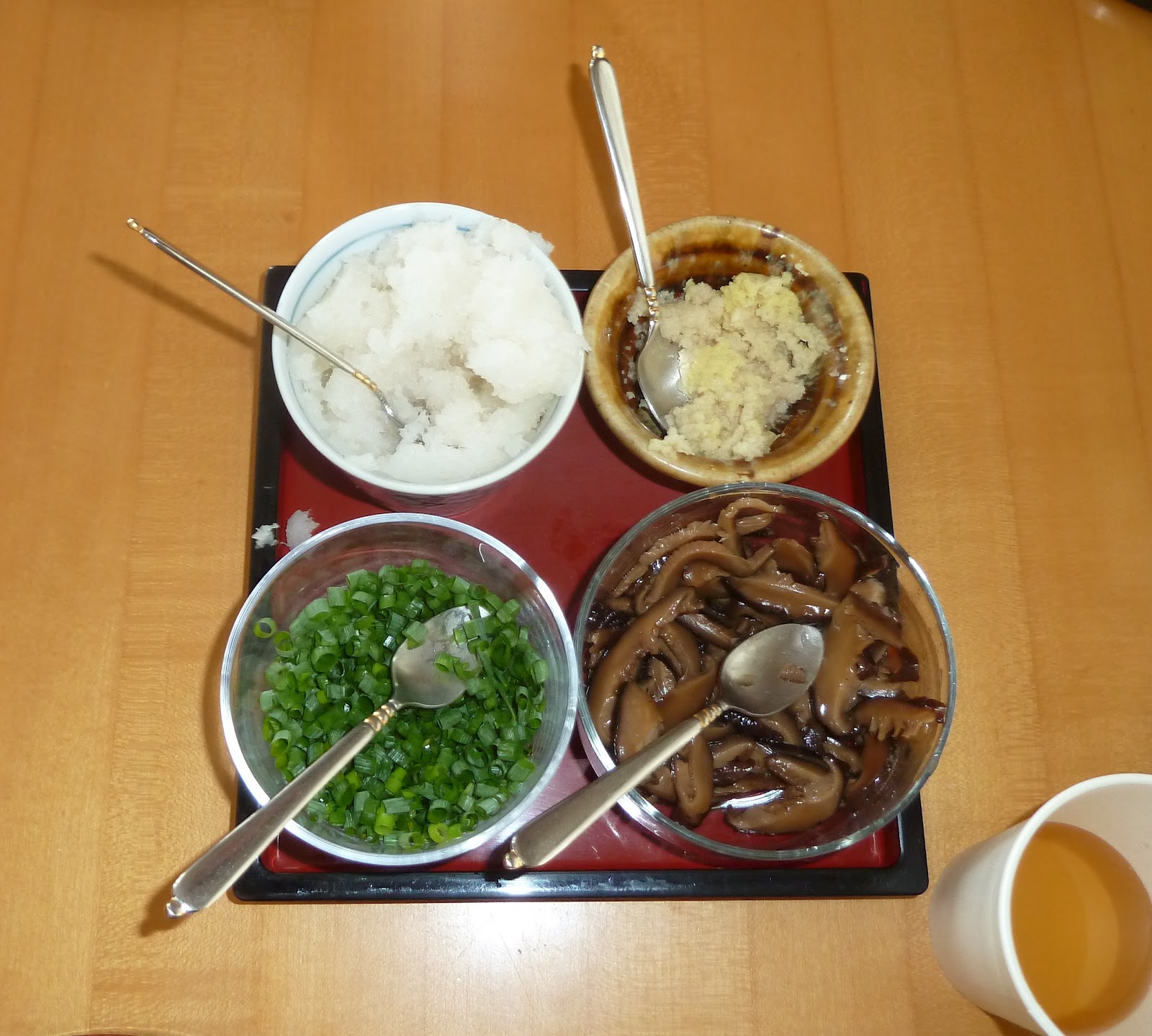
| Adding toppings: scallions, cooked shitake, grated diakon, and grated ginger |
 |
| Yummy lunch AND dueling sumo wrestlers, what more could you want? |
 |
| Left to right, clockwise: grated diakon, grated ginger, shitake, scallions |
 |
| Here's something I bet you didn't know: Sesame seeds come from this lovely flower! |
 |
| My cold noodle salad. It was absolutely fantastic! |
After our noodle lunch, it was time for rolling and cutting the noodles. The rolling reminded me and the boys of making pie crust:
 |
| First you sprinkle the dough with a little flour, then fold it into a square. |
 |
| Roll, roll, roll |
 |
| Many hands make light work. |
 |
| Eventually, the dough looks something like this. |
Once the dough is rolled out into a rectangular shape and is quite thin, it is ready to cut. First you fold the dough like a fan, and then you cut it into noodles. (Notice I had NOTHING to do with the cutting):
Here's a video of Ms. Andoh showing AH the proper technique:
 |
| Noodles cut and ready to cook! |
While the noodles cooked (usually 7 to 10 minutes, but these were quite thick and required more time), we got ready to eat again--this time hot udon!
 |
| Done! |
Our second meal was as delicious as the first. Maybe a bit more delicious because this time some of the noodles we ate were the ones the kids had made!
Of course, no meal on a hot summer day would be complete without ice cream, and Ms. Andoh was sure that the kids did not leave disappointed!
She served all the kids--old and young--
moano, which is a vanilla ice cream sandwich that is completely encased in a thin wafer cone for the sandwich part. I LOVE IT! I was so busy eating, I didn't take any pictures. Luckily, Ms. Andoh was nice enough to share a couple of pictures:
That brought our cooking class to a full and happy end. We were sad to say goodbye, but we have good reason to hope that Ms. Andoh will be in the NYC area soon and that she will be offering a cooking class or two. (She may also be in the Seattle area, so stay tuned!) So who knows, maybe you too can have your own stateside Japanese culinary adventure!
And here's your special treat for reading to the end...check out
Roots and Grubs, the blog of food writer (and dad) Matthew Amster-Burton. Though based in Seattle, he and his family were part of our class, and his delightful book,
Hungry Monkey: A Food-Loving Father's Quest to Raise an Adventurous Eater, is a fine read for summer (or anytime).